Showing posts with label guilt. Show all posts

Friday, July 17, 2015

7 Steps To Stop Feeling Guilty


Got guilt?  

Feeling guilty for what you're eating may distract from a stronger guilt and/or shame about having needs and wanting more (of anything).

What's the difference between guilt and shame?

Guilt can be understood as being about something that you did or did not do.  It references behavior and actions.   People feel guilty when they think they've done something wrong, or when they choose not to take action.   

Guilt sounds like:  "I've done something really bad and wrong."

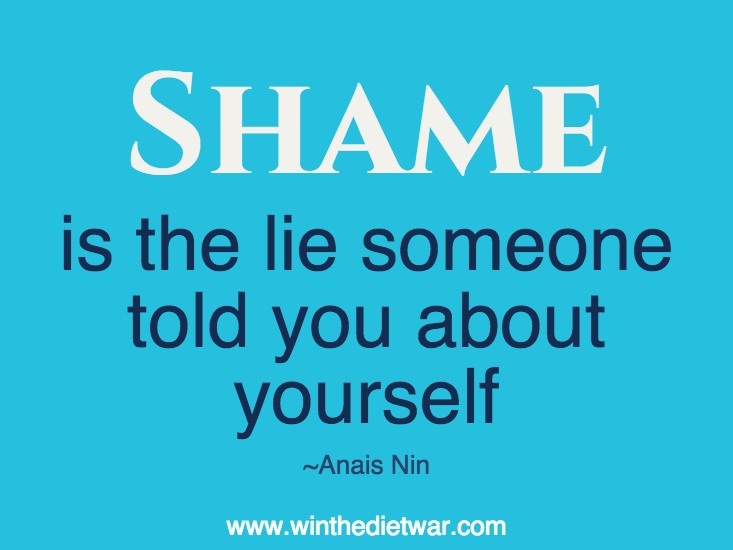
Shame about who you are as a person, your essential character.   It's not that you've done a bad thing, but that there's something essentially bad about you.  Shame is often associated with secrecy and leads to isolation.

Shame sounds like:  "There's something really bad and wrong with me."

Here's how to get rid of guilt:

1.  Think of something that makes you feel guilty.  What is your "crime"?
"I feel guilty for eating that pizza" or "I feel guilty for wanting ice cream"


2.  Identify what the behavior means about you.
"I want too much and I have no self-control.  I am completely weak."


3.  If your guilt was not attached to food/weight, what might you feel guilty about?   "I'm not happy in my relationship" or, "I resent my friends/family."


4.  What are your rules for yourself about wanting and feeling?  "Don't want too much.  Don't be selfish.  Be happy with you have because other people have it so much worse.  Don't complain.  Don't be a whiner.  Who do you think you are?  Don't be full of yourself?  Don't be angry.  


5.  What do you imagine is wrong with your character, your basic and essential self?  "I'm needy.  I'm too much.  I'm not enough.  There's something missing in me.  I'm not lovable.  I'm deficient."


6.  Where did you learn to relate to yourself this way?   "Childhood, family, experiences in school, relationships with friends and/or romantic situations."

 
7.  What is another way of looking at this situation and your behavior? 
"I'm still learning to identify and process my feelings.  I have conflicts about wanting more out of life, and that makes me feel needy.  Wanting more is not bad, or shameful, but human.  I will be curious about where in my life I feel deprived, so I don't turn to food to get "more" or to express my conflict over wanting more out of life by eating"

When you identify and process your core guilt and shame, you'll be less likely to attach your guilt/shame to your weight, food or body image.

That's how you make peace with food!

*          *          *


Wednesday, March 4, 2015

How To Say NO To People


Is it difficult to say "no" to people?

Do you often agree to do things you don’t want to do?  Feel like you give in too easily? 

I'm going to show you how to say "no" with more ease.  First, identify why it's so tough to set boundaries with others.  Some common reasons include:

You feel guilty – as if it’s wrong to choose yourself

You feel like a burden – as if it’s asking too much to choose what you want if someone else wants something different

You don't want to seem difficult – as if saying no makes you difficult and too much trouble

You don't want to upset anyone – as if you’re responsible for the feelings of others

You're afraid to hurt someone’s feelings – as if what another person wants, thinks or feels is more important than what you want, think or feel

You fear rejection – as if people won’t like you or want to be your friend if you disappoint them

You fear retaliation – as if people will reject/hurt/abandon you if you displease them

Which of these resonates with you?

What does this have to do with food & disordered eating?

If you say “yes” when you really mean “no,” what happens to your resentment towards the person making the request?  Or your anxiety about doing something you don't want to do?   When you don’t express emotions in words, you’re vulnerable to disordered eating in the following ways:

*Turning to food for comfort or distraction.  
*Bingeing and purging as a way of symbolically ridding yourself of your emotions.
*Restricting as a symbolic way to deny that you feel anything.
*Getting upset at yourself for your weight 

How do you avoid this?  By saying “no” when people ask you to do something you don’t want to do.  

Here's how to say "No":

Step One: acknowledge the other person’s request:  

“I know you really need or want me to _____”

Step Two: set the limit.  “...But that doesn't work for me."

Example:  Imagine a friend asks to borrow money. 

Step One is, "I understand you're in a tough place right now...."  
Step Two is, "...but I make is a rule not to lend money to friends."

That way it's not personal.  This is your rule, these are your boundaries, and you'll feel less rejecting.

Example:  Imagine you hate horror movies but your friend/spouse/partner wants to see the latest scary movie.  

Before you commit to a night of hiding behind your hands and having nightmares later, say, "I know you'd really love to see  that movie, but those movies give me nightmares and I don't enjoy them.  How about seeing something we'll both like?"

It gets easier with practice!

Step Three:  Take your own side

Don’t apologize, Don’t make excuses, Don’t justify or explain.  Do set limits.


Step Four:  Give yourself the right to have rights.

You have the right to set boundaries, the right to you’re your needs, wants, time and interests as important as those of others.  

When you are comfortable with those rights, you won’t need to comfort or distract yourself with thoughts of diet, weight, exercise or calories.  And that's how you make peace with food!

*     *     *     


Saturday, February 9, 2013

Magic Wand


I have a magic wand in my office.  If only it worked the way Harry Potter's does in books and movies!  

If my wand had actual powers, I'd wave it over people and magically heal their relationship to themselves. I'd instantly create self-acceptance to replace self-criticism and help people process feelings instead of turning on themselves, using food/weight as a weapon.  

Alas, the magic wand doesn't work.  But here's the good news:  you do have the power to change, to identify patterns and destructive attitudes and to react and act differently in your life.  

We all have our own magic within us.  We can heal ourselves with a combination of insight, hope, tenacity, reflection, courage, and more.

Eating disorder behavior and thoughts often serve to distract from deeper fears and conflicts.  When you can work through these concerns, you may no longer need the eating disorder to cope with the uncomfortable/unbearable feelings that arise from them. Imagine if in a wave of a magic wand, all thoughts of food, weight, calories, fat grams, or anything connected to disordered eating are completely blocked.  If these concerns no longer occupied your mind, what would you think about? 

Fear of abandonment: concern that others will leave you and that you’ll be alone. Is this a familiar concern?  If so, what comes to mind?

Fear of rejection: concern that other people will judge you and won’t like you.  When is the first time you remember feeling this way?

Fear of punishment:  Fear that you’ll get in trouble or be punished in some way.  Do you feel this way a lot? 

Guilt:  Feelings of guilt or fear that you’re going to feel guilty in the future.  Often this guilt leads to anxiety, which is felt as one of the above fears.  For example, “If I do something wrong, then others are going to react by either abandoning, rejecting or punishing me."

Addressing the underlying fear and working through it, what it is and where it came from (easier said than done!!) can help you be less worried about these issues.  And when you're not as worried, anxious or fearful, you are less likely to turn to or from food to cope.

FREE:  Crack The Code of Emotional Eating!


Ready for the FULL PROGRAM?

Give me 30 days to transform your relationship to food 
(without actually talking about food).

CLICK << HERE >> 

Sunday, January 13, 2013

The 'F' Word:


Dr. Nina talks about the "F" word:  Feelings.  She discusses seven basic feelings that often lead to overeating.  Learn to identify, gauge, and process a range of emotions, so you won’t need food to escape what you're feelings.  Dr. Nina helps you be curious about yourself, instead of critical.  When you can figure out what you're feeling and respond to yourself with words, you're less likely to turn to food.

Check out this episode!


FREE:  Crack The Code of Emotional Eating!


Ready for the FULL PROGRAM?

Give me 30 days to transform your relationship to food 
(without actually talking about food).

CLICK << HERE >> 

Thursday, January 10, 2013

Being vs. Doing


We’re human beings, not human doings!

Our society values productivity and accomplishment. If you grow up in a family (and a culture) that is primarily or solely interested in what you're doing, accomplishing and achieving, you learn to value yourself by being productive; it becomes the basis of self-esteem. 

When others express interest only in your accomplishments, you learn to value yourself only for what you have achieved.  When others dismiss or devalue your feelings, you learn to do the same.  Feelings become frightening and a source of anxiety. Disordered eating is a way of coping with those feelings.  So is staying busy and focused on achievements.


Doing can serve as a distraction from your emotions.  It can take the form of:

*Working all the time
*Going online all the time
*Going to the gym
*Running errands
*Having the TV on all the time
*Going out and seeing friends all the time
*Thinking about what you need to do next/making lists
*Thinking about calories, fat grams, the number on the scale

Being puts you in touch with your emotions.   It looks like this:

*Being alone
*Staying aware of  thoughts and feelings
*Comforting and soothing yourself with words
*Relaxing

How do you keep busy?

How did you learn to use “doing” to escape “feeling”?

What happens if you are alone with yourself?

What are you afraid you might think?

What are you afraid you might feel?

When you can "be" with yourself and process any feelings or conflicts you might experience, you are less vulnerable to turning to (or from) food to distract yourself from those uncomfortable states.


*     *     *     *     *

Ready to KICK THE DIET HABIT?

Give me 30 days to totally transform
your relationship to food

(without actually talking about food).


SIGN UP << HERE >> to get started.

FREE video series:  Crack The Code of Emotional Eating!

<<<< CLICK HERE >>>>>