Showing posts with label shame. Show all posts

Wednesday, February 12, 2020

The Dr. Nina Show: "The Battle Of The Blueberry Muffin"


Dr. Nina talks with psychologist Dr. Aleta Edwards about her book, Fear Of The Abyss, which explores themes of shame, control and perfectionism. Dr. Nina discusses how shame impacts our relationship with ourselves and with food. She also explores why caller Nicole experienced a “battle with a blueberry muffin.” Don’t miss this fascinating show!

Grab your free copy of Dr. Nina's book The Binge Cure: 7 Steps To Outsmart Emotional Eating (just cover shipping): www.drnina.info.

Friday, July 17, 2015

7 Steps To Stop Feeling Guilty


Got guilt?  

Feeling guilty for what you're eating may distract from a stronger guilt and/or shame about having needs and wanting more (of anything).

What's the difference between guilt and shame?

Guilt can be understood as being about something that you did or did not do.  It references behavior and actions.   People feel guilty when they think they've done something wrong, or when they choose not to take action.   

Guilt sounds like:  "I've done something really bad and wrong."

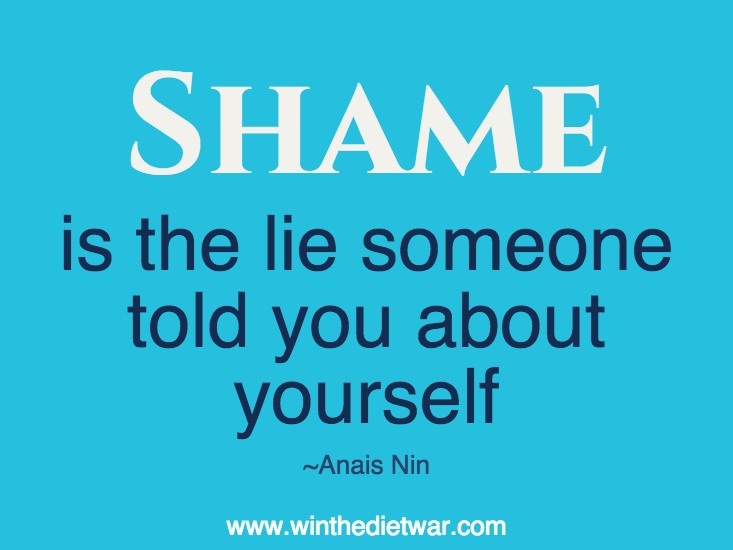
Shame about who you are as a person, your essential character.   It's not that you've done a bad thing, but that there's something essentially bad about you.  Shame is often associated with secrecy and leads to isolation.

Shame sounds like:  "There's something really bad and wrong with me."

Here's how to get rid of guilt:

1.  Think of something that makes you feel guilty.  What is your "crime"?
"I feel guilty for eating that pizza" or "I feel guilty for wanting ice cream"


2.  Identify what the behavior means about you.
"I want too much and I have no self-control.  I am completely weak."


3.  If your guilt was not attached to food/weight, what might you feel guilty about?   "I'm not happy in my relationship" or, "I resent my friends/family."


4.  What are your rules for yourself about wanting and feeling?  "Don't want too much.  Don't be selfish.  Be happy with you have because other people have it so much worse.  Don't complain.  Don't be a whiner.  Who do you think you are?  Don't be full of yourself?  Don't be angry.  


5.  What do you imagine is wrong with your character, your basic and essential self?  "I'm needy.  I'm too much.  I'm not enough.  There's something missing in me.  I'm not lovable.  I'm deficient."


6.  Where did you learn to relate to yourself this way?   "Childhood, family, experiences in school, relationships with friends and/or romantic situations."

 
7.  What is another way of looking at this situation and your behavior? 
"I'm still learning to identify and process my feelings.  I have conflicts about wanting more out of life, and that makes me feel needy.  Wanting more is not bad, or shameful, but human.  I will be curious about where in my life I feel deprived, so I don't turn to food to get "more" or to express my conflict over wanting more out of life by eating"

When you identify and process your core guilt and shame, you'll be less likely to attach your guilt/shame to your weight, food or body image.

That's how you make peace with food!

*          *          *


Saturday, April 6, 2013

Don't "Should" On Yourself!


I'm on a mission to banish the word "should" from our vocabulary.  The word makes people feel bad about themselves and promotes shame, guilt and other difficult emotions.

Here's why:

Definition of "Should": To express obligation or duty; also used to express expectation, conditionality.


The way we speak to ourselves can directly influence the way we feel, which in turn can impact behavior. If you feel terrible about yourself, you might turn to (or from) food to comfort, soothe, or distract from the intolerable feeling.

When you relate to yourself in a kinder way, you will feel better and therefore need to turn to disordered eating as a way of coping.

How many times have you told yourself:

I should not do that.
I should not have eaten that.
I shouldn’t eat that.
I shouldn’t want that.
I should be better at this.
I should get a better job.
I should have a boyfriend/girlfriend.

Even if you say, “I should be happy” it implies that you’re not as happy as you could be.

Often we speak to ourselves in second person, as if someone else is talking to us:

You shouldn't have said that.
You shouldn’t have eaten that.
You shouldn’t have done that.
You shouldn’t want that..
You should do better.
Whose voice does that sound like? Is it familiar?

The word “should” can cause us to direct anxiety, sadness, anger, and distress towards ourselves.Those feelings may be so powerful that we use disordered eating to cope.

Instead of “I/you should not do that” ask yourself: 

What do I want? What am I feeling? What’s going on with me right now?

Be interested in your thoughts/emotions rather than judgmental.

When you're self-critical, you feel bad.  When you respond to yourself with kindness and interest, when you soothe yourself with words, you're less likely to turn to or from food in order to comfort, numb or distract yourself from what's going on inside.


Graphic by Talia Ellis, www.ellistic.net

Friday, March 8, 2013

Stay out of your head (and the fridge)


Check out this episode!

Are you trying to think away your emotions? 

Many people use logic to try to talk themselves out of their anger, sadness, fear, anxiety and/or guilt. Problem is, what you know intellectually doesn’t affect what you feel emotionally. 

This episode helps you stop thinking and start feeling, so you’re less likely to turn to food when you're upset.


Saturday, January 26, 2013

Feelings Are All Right


Recently Sloane (not her real name) arrived late. Before our session she had an appointment with a realtor, who got a flat tire and was over thirty minutes late - which in turn made her late for the session.    

“I’m so, so sorry,” she apologized. “I wouldn’t blame you if you were upset. It’s so rude and disrespectful for me to be this late.”

I wondered if she was upset at the realtor who kept her waiting.

“Not at all,” she shrugged. “It’s not his fault that he had a flat tire. I don’t have the right to be upset. I can’t be mad if there’s a good reason for what happened.”

Although she expected me to be upset that she was late, also for circumstances outside her control, she could not give herself the same right.

“You know what really upsets me? The bagel I ate for breakfast. Disgusting!”  She went on to criticize her weight, her lack of control and various other perceived deficiencies.

Sloane did not give herself the right to be angry that she’d been kept waiting, whatever the circumstances, and instead expressed that anger and frustration by finding fault with her body and life choices.
She denied her anger, and then took it out on herself.


Feelings are not rational.  Emotions are outside the purview of logic.   If you deny and dismiss your feelings towards other people, it’s likely that you will turn on yourself in one of the following ways: 
·      Eating to express the feelings via the action of eating (ie, expressing anger by eating something crunchy like chips, an apple, pretzels).
·      Using food for comfort (ie, eating ice cream, cookies, soothing food).
·      Redirecting your feelings by attacking your body (as in the example above).

Here are some other ways people dismiss or deny their feelings:

·      “I’m mad at the situation, not the person”
·      “I shouldn’t feel that way. “
·      “It’s wrong to be angry” or “It’s not nice to be upset”
·      “I don’t want to be an angry (depressed/anxious/) person.”
·      “So what if that bothered me?  Other people have it a lot worse!”


Do any of these statements sound familiar?  If so, give yourself the right to feel what you feel.
Feelings aren’t a reflection of your character or personality.  They are reactions to situations.

Your feelings need your attention, not your condemnation!

FREE:  Crack The Code of Emotional Eating!


Ready for the FULL PROGRAM?

Give me 30 days to transform your relationship to food 
(without actually talking about food).

CLICK << HERE >> 

Sunday, January 13, 2013

The 'F' Word:


Dr. Nina talks about the "F" word:  Feelings.  She discusses seven basic feelings that often lead to overeating.  Learn to identify, gauge, and process a range of emotions, so you won’t need food to escape what you're feelings.  Dr. Nina helps you be curious about yourself, instead of critical.  When you can figure out what you're feeling and respond to yourself with words, you're less likely to turn to food.

Check out this episode!


FREE:  Crack The Code of Emotional Eating!


Ready for the FULL PROGRAM?

Give me 30 days to transform your relationship to food 
(without actually talking about food).

CLICK << HERE >> 

Friday, December 28, 2012

Guilt Trip? For shame!


GUILT & SHAME

"Guilt is a rope that wears thin."
                   -Ayn Rand, Atlas Shrugged

“We need never be ashamed of our tears.” 
                  ― Charles Dickens, Great Expectations

Disordered eating can distract you from intolerable emotions and conflicts.  It's easier to focus on food/weight/behavior than to experience difficult thoughts and feelings. Feeling guilty or ashamed for what you’re eating (or not eating) or how much you weigh can be a distraction from a deeper sense of guilt and/or shame about your needs, wants, and core self.

GUILT can be understood as being about something that you did or did not do.  It references behavior and actions.   People feel guilty when they think they’ve done something wrong, or when they choose not to take action.   Guilt sounds like:  “I’ve done something really bad and wrong.”

SHAME is about who you are as a person, your essential character.   It’s not that you’ve done a bad thing, but that there’s something essentially bad about you.  Shame is often associated with secrecy and leads to isolation.Shame sounds like:  “There’s something really bad and wrong with me.”

Understanding your behavior around food (or anything) can help mitigate the feelings about the behavior and make you feel less guilty and shameful.  

Think of something that makes you feel guilt and/or shame.  What is your “crime”?
(ie, “I feel guilty for eating that pizza” or “I feel guilty for wanting ice cream”)


What does the behavior mean about you?
(ie, “I want too much and I have no self-control.  I am completely weak.”)


What is another way of looking at this situation and your behavior? 
(ie, “I have conflicts about wanting more out of life, and that makes me feel needy.  Wanting more is not bad, or shameful, but human.  I will be curious about where in my life I feel deprived, so I don’t turn to food to get “more” or to express my conflict over wanting more out of life by eating more or bingeing and purging, or by restricting.”)


If you feel guilty about eating too much, or restricting, or bingeing and purging, ask yourself what you feel guilty about that has nothing to do with food.   If your guilt is not attached to food/weight, what might you feel guilty about?  


If you feel a pervasive sense of shame, a sense that there is something inherently wrong with you, what is so bad about you?  


What do you imagine is wrong with your character, your basic and essential self?


Where did you learn to relate to yourself this way?  

When you identify and process your core guilt and shame, you’ll be less likely to express those emotions through disordered eating. 


Comments and questions are welcome.  Please share on Facebook and/or Twitter so more people can benefit from the information on this blog.

"Like" me on Facebook and follow me on Twitter


Legal Disclaimer:  The content on this site is for educational and informational purposes only.  It is not intended as psychotherapy or as a substitute for psychotherapy advice, diagnosis or treatment.