Showing posts with label psychoanalysis. Show all posts

Monday, December 11, 2017

"One bite won't hurt you!"


Recently one of the listeners to my radio show wrote in and asked how to get food pushers to back off.  

She said, "People who say, 'Oh, come on, it's the Holidays. Just this one time. It's a time for indulgence." Or hosts who say, "You barely ate anything. Have some more. It's just a little." 


She wanted to know what to do about hosts who put the food on your plate rather than letting people put take own portions. 

(Or worse, what to do about the dreaded buffet party).

Here are my recommendations:

Prepare clever comebacks

Benjamin Franklin once said, “By failing to prepare, you are preparing to fail.”  Conversely, by preparing, you will succeed!

Going home for the holidays can cause a temporary regression.  If you feel like a five year old as soon as you step through the doors of your childhood home, it can be difficult to retain your adult self. 

Having snappy comments at the ready will help get you through.

For people who say, "One bite won't hurt you." (or something like that)

Respond with one of the following comebacks:

"In that case, only give me one bite."
"You're very interested in what I'm eating, aren't you?"
"Would you tell someone who's trying to smoke that one cigarette won't hurt?  Would you tell an alcoholic that one sip of alcohol won't hurt?"  

(I don't believe in food addiction, which I discuss in this post, but the point of these comebacks is to get people to back off, and this strategy is very effective).

For hosts who dole out food, it's perfectly acceptable to say, "Thank you so much, but I'll take my own."

If they say, "I insist on serving you myself" (which, is highly unlikely), say, with a smile, "You're working too hard, so I insist on helping you by fixing my own plate."

As for buffets, it may be helpful to ask a friend to make you a light and healthy plate, which helps you avoid temptation.

The point here is not to defend or explain, but to challenge these food pushers and put them on the defensive.

It also helps to be ready for comments and questions about your food choices and your weight, such as:

“Do you really need to eat that?” 
“You’ve put on a few pounds since last year.”

There are three ways to deal with these types of comments.

Set limits:

“I’m not discussing what I’m eating or how much I weigh. Period.”
“I don’t like speaking about my weight, so I prefer you don’t bring it up.”

Use Humor:

“No, I don’t need that.  But I sure do want it.  Is there a problem?”
“My weight is a number and it’s unlisted.”
“Thank you for noticing.  And here I thought nobody paid attention to me.”
“Absolutely right.  Curvy is the new black, didn’t you hear?”
“Wow, I actually HAVE gained weight.  Thank you for letting me know because otherwise it would have completely escaped my attention.”


Deflect:  

So what?  What’s new with you?
Maybe.  So how are you these days?
My weight really isn’t that interesting to me.  What are your plans for next year?

If they tell you that they are only asking because they are worried about your health, say:

“I appreciate your concern, but I do not want to discuss this.”

And, remind yourself:  this is TEMPORARY.   Before you know it, the New Year will be here and you will have gotten through the holidays without gaining weight!


Haven't heard my show yet?  Listen LIVE here on LA Talk Radio or get all the episodes on iTunes.


Here's that link again:  latalkradio.com/content/dr-nina-show

Saturday, October 26, 2013

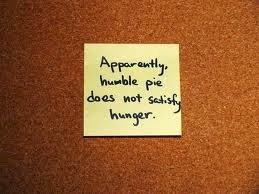
Don't Eat Humble Pie!


Are you too humble?

It's one thing to be humble - to be modest and give a low estimation of your value.

It's another thing to devalue yourself, underestimate yourself or be too quick to point out perceived faults and flaws.

How do you talk to yourself or about yourself?


"I can't be seen in public until I lose weight."
"I'm such an idiot."

"I can't believe I went out with that guy.  I'm a loser." 

Does that sound familiar?  Are you overly humble and self-critical?  When you talk about yourself, are you referring to your physical, emotional, intellectual, or relational self?  


If you only define yourself by what you look like, or put yourself down for perceived deficits, you're missing the whole picture. When you appreciate all your qualities, your view of yourself will change. 

A pie chart is a great way of seeing the whole you.

List the qualities about yourself that have nothing to do with your physicality.  Include things you like as well as things you don't like about yourself:  e.g., smart, funny, creative, warm, compassionate, loving, shy, spirited, zealous, bossy.
Then divide the pie below to represent each of these qualities.


Follow the example and list the qualities about yourself in the following categories:

Emotional                  Intellectual               Relational                  Other (not physical)

______________         ______________       ______________        _____________
______________         ______________       ______________        _____________
______________         ______________       ______________        _____________
______________         ______________       ______________        _____________
______________         ______________       ______________        _____________
______________         ______________       ______________        _____________
______________         ______________       ______________        _____________

Now, divide up the qualities on the pie chart below.


How does it feel to look at this chart?  What do you notice about this perspective of yourself?  What surprises you?   Is your mind conflicted between acceptance and indifference?  Why?

Having a more realistic self-concept facilitates self-acceptance.  When you appreciate who you are as a person, you feel better about yourself.  And when you feel better, you’re less likely to turn to (or from) food for comfort or distraction from uncomfortable thoughts and emotions about yourself.

Friday, September 27, 2013

The "F" Word (It's not what you think)


If you struggle to identify and process your emotions, you're more likely to turn to food for comfort or distraction.  In this episode, Dr. Nina explains that the only way to get rid of feelings is to actually FEEL them. She demonstrates the difference between thinking about your emotions and expressing them. When you can identify and process what's going on inside, you won't use food to cope!

Remember, feelings are reactions to situations, not character flaws!

Watch the video for more food for thought.


Friday, September 13, 2013

Balance Your Life (& the Scale)


On the ladder of life, are you always scrambling to get to the next rung, always trying to get somewhere, to achieve something? 

"When I lose weight, then I'll start dating."
"When I'm a size zero, I'll be perfect."
"When I finish grad school, my life will be great."
"When I get a new job, then I'll be happy."
"When I get a promotion, I'll feel good about myself."

Goals are great – but if you're always looking to the future, you're never really in the present.  If what you want exists only in the future, you never have what you want.  Deprivation leads to a sense of emptiness, and feeling empty may cause you to turn towards (or away from) food as a way of comforting, soothing, or distracting yourself.

If you can balance appreciating your progress from the past, looking towards the future and what you hope to achieve, with being where you are - in the moment - you'll probably feel better.   You don't need to turn to disordered eating (or other things) to cope, if you feel good.

“Yesterday is history, tomorrow is a mystery, today is a gift.  That's why it's called the present.”


Want more help making peace with food?  


Friday, September 6, 2013

Trying to lose weight? It's NOT About Willpower!


Think you're a food addict, a binge eater, a compulsive overeater?  You're NOT!  Dr. Nina gives viewers a new way to think about their struggle with food, weight and body image.


Thursday, September 5, 2013

Is Your Diet Failing You?


Does the phrase “pool party” create anxiety or dread?  If the idea of BBQs and bathing suits makes you wish you'd stayed on your diet all summer, then consider this:  

Maybe you’re not a failure at dieting; maybe dieting has failed you.


In this episode Dr. Nina explores ideas about failure and success, and how that influences your measure of yourself and your self-worth.  When you feel successful, you’re more likely to feel good about yourself in general - and when you feel good, you’re not as likely to turn to food for comfort or escape. 

She reminds listeners that if you fail at something, that doesn’t mean you are a failure.  After all, the “u” in failure is not spelled Y.O.U. J  When you personalize the failures in your life, you feel bad about yourself.   The failure becomes a character flaw, instead of a situation that didn’t work out. 

Dr. Nina gives examples of very successful people built their success on the steps of failure, such as Michael Jordan (who lost many games, and many shots),  Steve Jobs (who was fired from Apple),  Oprah Winfrey (who was fired from her job as a TV reporter) and Thomas Edison (who unsuccessfully tried for years to invent the light bulb).

She suggests that if you’ve been dieting to lose weight, then you haven’t failed at dieting; dieting has failed you.  That’s because diets deal with food, with WHAT you’re eating, and not WHY.

Are you lonely, upset, or helpless?  Are you happy and this is the only way you know how to celebrate?  Are you rewarding yourself?  Punishing yourself?  Avoiding something painful or upsetting?  What’s going on?

Dr. Nina proposes a new way to think about success.  Instead of dieting, try responding to your thoughts and emotions in a new way. 
When you can identify and process what’s going on inside – the emotions, conflicts and states of mind that are hard to be with - you won’t need food to distract you from those things, and that’s how you lose weight for good.  


Check out this episode!


Subscribe to the new Dr. Nina Show on YouTube!

For media inquiries:  Online Press Kit

Comments and questions are welcome.  Please share on Facebook and/or Twitter or leave a rating and/or a comment on iTunes, so more people can benefit from the information on this blog.

Legal Disclaimer:  The content on this site is for educational and informational purposes only.  It is not intended as psychotherapy or as a substitute for psychotherapy advice, diagnosis or treatment.