Showing posts with label food issues. Show all posts

Thursday, December 1, 2016

Getting Over Overeating For Teens

I'm so pleased to welcome back psychotherapist Andrea Wachter, who is sharing excerpts from her latest book.  Although this book is geared towards teenagers, it can benefit people of any age!


The following excerpts are from Getting Over Overeating for Teens by Andrea Wachter, LMFT. They are reprinted with permission from New Harbinger Publications, Inc. copyright © 2016 For more details, click here: http://www.andreawachter.com/books/

If you’ve been struggling with overeating, you’re not alone. And the most important thing to know is that it is not your fault! We live in a culture that gives us some pretty crazy messages about food, fitness, and feelings. On top of that, most teens have lots of stress dealing with friends, family, and finals. (Well, homework too, but I was on such a roll with words that start with F I figured I’d go with finals!)
Most of us, including our parents, haven’t been taught how to deal with food, fitness, and feelings in really healthy ways. We all get taught the same mixed messages—but the good news is that we can actually delete our unhealthy habits and upgrade to healthier ones.
Let’s start out with a quick definition of overeating, and how it’s different from bingeing. Overeating is when you eat more than your body needs. Even people who have a totally healthy relationship with food will overeat occasionally. It becomes a problem only if they do it too often or if it has negative consequences.
Binge eating is when someone eats a large amount of food in a short amount of time. They usually eat fast and until they are stuffed and ashamed. And they usually eat over painful emotions and thoughts, rather than out of true physical hunger.
I started overeating (and dieting, sneak eating, bingeing, and struggling with my weight) when I was a teenager. It took me a lot of years and tears to find the right kind of help, but I finally did. And now I have the privilege of teaching others (including you) all the things that helped me get over overeating.
Even though overeating can feel pretty comforting while we’re doing it, it can definitely leave us feeling pretty lousy after we’re done. And no matter how good food tastes while it’s going down, if we’re eating more than our body needs and for reasons that have nothing to do with physical hunger, it’s going to have negative effects— physically, emotionally, mentally, and socially.
Overeating is definitely one way to stuff down painful feelings. The only problem is that when we stuff down our pain, we also stuff down our passion, happiness, and excitement. It’s like damming a river; you hold back all the water, not just some of it.
Getting over overeating means getting back some of the joy, excitement, and peace that might be missing in your life. It means finding healthier ways to get sweetness and comfort. It means learning to eat foods you really love, in amounts that satisfy your body’s needs, and finding new ways to satisfy the rest of your needs.
Don’t Believe Everything You Think!

Have you ever had the experience where one minute you’re going about your day feeling fine and the next minute you have a horrible thought? It’s probably not because something horrible happened. Well, maybe something happened, but usually it’s because a horrible thought popped into your mind.
We all have automatic thoughts that pop up in our minds, just like we have pop-up ads on our computer screens. It’s so easy to believe our thoughts. After all, they are our thoughts! They seem and feel so real, but the truth is, our thoughts aren’t always real, and they sure aren’t always helpful, kind, or true. The good news is that, just like we can close those unwanted pop-up ads on our computers with a simple click, we can learn to close the pop-ups in our minds.
Filling Up Without Feeling Down

It’s pretty easy in our fast-paced world to focus on feeding our bodies and feeding our minds. But if we want to get over overeating, we also have to feed the deeper parts of ourselves that can’t be seen, the parts of us that have nothing to do with the material world—our hearts and our souls. These are places that food won’t fill. If we overfeed our bodies, we might be full, but not truly fulfilled. If we feed only our minds, we might think and learn a lot, but we won’t be really satisfied. We all need to fill our spirits too, on a regular basis. When you truly feed your spirit, you feel better afterward. You feel truly filled up, and there are no negative or harmful consequences.


Andrea Wachter is a Licensed Marriage and Family Therapist and author of Getting Over Overeating for Teens. She is also co-author of Mirror, Mirror on the Wall: Breaking the “I Feel Fat” Spell and The Don’t Diet, Live-It Workbook. An inspirational counselor, author and speaker, Andrea uses professional expertise, humor and personal recovery to help others. For more information on her books, blogs and other services, please visit: www.andreawachter.com


Saturday, October 26, 2013

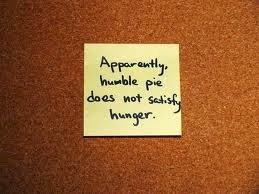
Don't Eat Humble Pie!


Are you too humble?

It's one thing to be humble - to be modest and give a low estimation of your value.

It's another thing to devalue yourself, underestimate yourself or be too quick to point out perceived faults and flaws.

How do you talk to yourself or about yourself?


"I can't be seen in public until I lose weight."
"I'm such an idiot."

"I can't believe I went out with that guy.  I'm a loser." 

Does that sound familiar?  Are you overly humble and self-critical?  When you talk about yourself, are you referring to your physical, emotional, intellectual, or relational self?  


If you only define yourself by what you look like, or put yourself down for perceived deficits, you're missing the whole picture. When you appreciate all your qualities, your view of yourself will change. 

A pie chart is a great way of seeing the whole you.

List the qualities about yourself that have nothing to do with your physicality.  Include things you like as well as things you don't like about yourself:  e.g., smart, funny, creative, warm, compassionate, loving, shy, spirited, zealous, bossy.
Then divide the pie below to represent each of these qualities.


Follow the example and list the qualities about yourself in the following categories:

Emotional                  Intellectual               Relational                  Other (not physical)

______________         ______________       ______________        _____________
______________         ______________       ______________        _____________
______________         ______________       ______________        _____________
______________         ______________       ______________        _____________
______________         ______________       ______________        _____________
______________         ______________       ______________        _____________
______________         ______________       ______________        _____________

Now, divide up the qualities on the pie chart below.


How does it feel to look at this chart?  What do you notice about this perspective of yourself?  What surprises you?   Is your mind conflicted between acceptance and indifference?  Why?

Having a more realistic self-concept facilitates self-acceptance.  When you appreciate who you are as a person, you feel better about yourself.  And when you feel better, you’re less likely to turn to (or from) food for comfort or distraction from uncomfortable thoughts and emotions about yourself.

Thursday, June 13, 2013

Be A Diet Wiz


Do you think you should be smarter, more compassionate or take more risks?  Do you keep parts of yourself hidden from friends or family?  

If so, the characters from The Wizard Of Oz can inspire you to challenge the negative or incorrect ideas you have about yourself.  

When you feel better, it’s easier to make better food choices and lose weight.

Check out this episode!


*          *          *


Wednesday, May 15, 2013

Weigh Your Words (skip the scale)


Check out this episode!


When you're upset, do you tell yourself to look on the bright side?   If so, you may be making things worse instead of better.  

In this episode, Dr. Nina explains the ways you may be dismissing yourself and offers suggestions on how to respond differently to yourself and how to tolerate difficult emotions.


*          *          *

 winthedietwar.com/new-ktdh-sales-page/

Thursday, May 2, 2013

Starving For Love?


What are you hungry for right now?   Is it food... or do you have a deeper hunger, for something  emotionally fulfilling?  

Maybe what you truly hunger for is love and connection.  

In this episode, Dr. Nina explores the connection between relationships and emotional eating.  She identifies four different attachment styles and how they impact your relationship to food.

Check out this episode!


Comments and questions are welcome.  Please share on Facebook and/or Twitter so more people can benefit from the information on this blog.

"Like" me on Facebook and follow me on Twitter

Legal Disclaimer:  The content on this site is for educational and informational purposes only.  It is not intended as psychotherapy or as a substitute for psychotherapy advice, diagnosis or treatment.

Friday, March 22, 2013

The Present


Do you often look to the future, imagining that when you are at your ideal weight, your life will be easier, happier, or perfect?   For example, “When I lose weight, I’ll find a boyfriend (or girlfriend).”  “When I stop bingeing, I’ll be more confident and social.”  

If this is familiar, you may be too focused on your weight to define yourself, giving a number on the scale too much power over your happiness and confidence.   Overly investing in your physicality as the determining factor in self-acceptance makes it difficult to appreciate the other qualities that make you loveable and likeable.    

Think of a vivid memory from the past.   How did it impact you?  What have you learned about yourself since then?   How have you changed?  


Imagine your future. What would you like to happen in the next week, month, year, five years, or decade?  (not weight-related)


Now, think of today.  What do you appreciate about yourself, in the here and now?  What qualities are likeable?  Lovable?  Interesting?   Are you a good friend?  Talented?  Funny?  Tenacious?  Smart?  Compassionate? Spirited?  Helpful?  Adventurous?  Loving?  

These are the qualities that define you, not the number on the scale.
Remembering this is a present you can give to yourself daily.


Saturday, January 26, 2013

Feelings Are All Right


Recently Sloane (not her real name) arrived late. Before our session she had an appointment with a realtor, who got a flat tire and was over thirty minutes late - which in turn made her late for the session.    

“I’m so, so sorry,” she apologized. “I wouldn’t blame you if you were upset. It’s so rude and disrespectful for me to be this late.”

I wondered if she was upset at the realtor who kept her waiting.

“Not at all,” she shrugged. “It’s not his fault that he had a flat tire. I don’t have the right to be upset. I can’t be mad if there’s a good reason for what happened.”

Although she expected me to be upset that she was late, also for circumstances outside her control, she could not give herself the same right.

“You know what really upsets me? The bagel I ate for breakfast. Disgusting!”  She went on to criticize her weight, her lack of control and various other perceived deficiencies.

Sloane did not give herself the right to be angry that she’d been kept waiting, whatever the circumstances, and instead expressed that anger and frustration by finding fault with her body and life choices.
She denied her anger, and then took it out on herself.


Feelings are not rational.  Emotions are outside the purview of logic.   If you deny and dismiss your feelings towards other people, it’s likely that you will turn on yourself in one of the following ways: 
·      Eating to express the feelings via the action of eating (ie, expressing anger by eating something crunchy like chips, an apple, pretzels).
·      Using food for comfort (ie, eating ice cream, cookies, soothing food).
·      Redirecting your feelings by attacking your body (as in the example above).

Here are some other ways people dismiss or deny their feelings:

·      “I’m mad at the situation, not the person”
·      “I shouldn’t feel that way. “
·      “It’s wrong to be angry” or “It’s not nice to be upset”
·      “I don’t want to be an angry (depressed/anxious/) person.”
·      “So what if that bothered me?  Other people have it a lot worse!”


Do any of these statements sound familiar?  If so, give yourself the right to feel what you feel.
Feelings aren’t a reflection of your character or personality.  They are reactions to situations.

Your feelings need your attention, not your condemnation!

FREE:  Crack The Code of Emotional Eating!


Ready for the FULL PROGRAM?

Give me 30 days to transform your relationship to food 
(without actually talking about food).

CLICK << HERE >>